
How America’s Farmers Turned Grain into Commerce
Editor’s Note: The Story Before the Barrel is an ongoing series exploring the forgotten agricultural roots of American whiskey. Before bourbon became an industry, it was a harvest. Before it was a barrel, it was a field. This series follows that journey back to where it truly began.
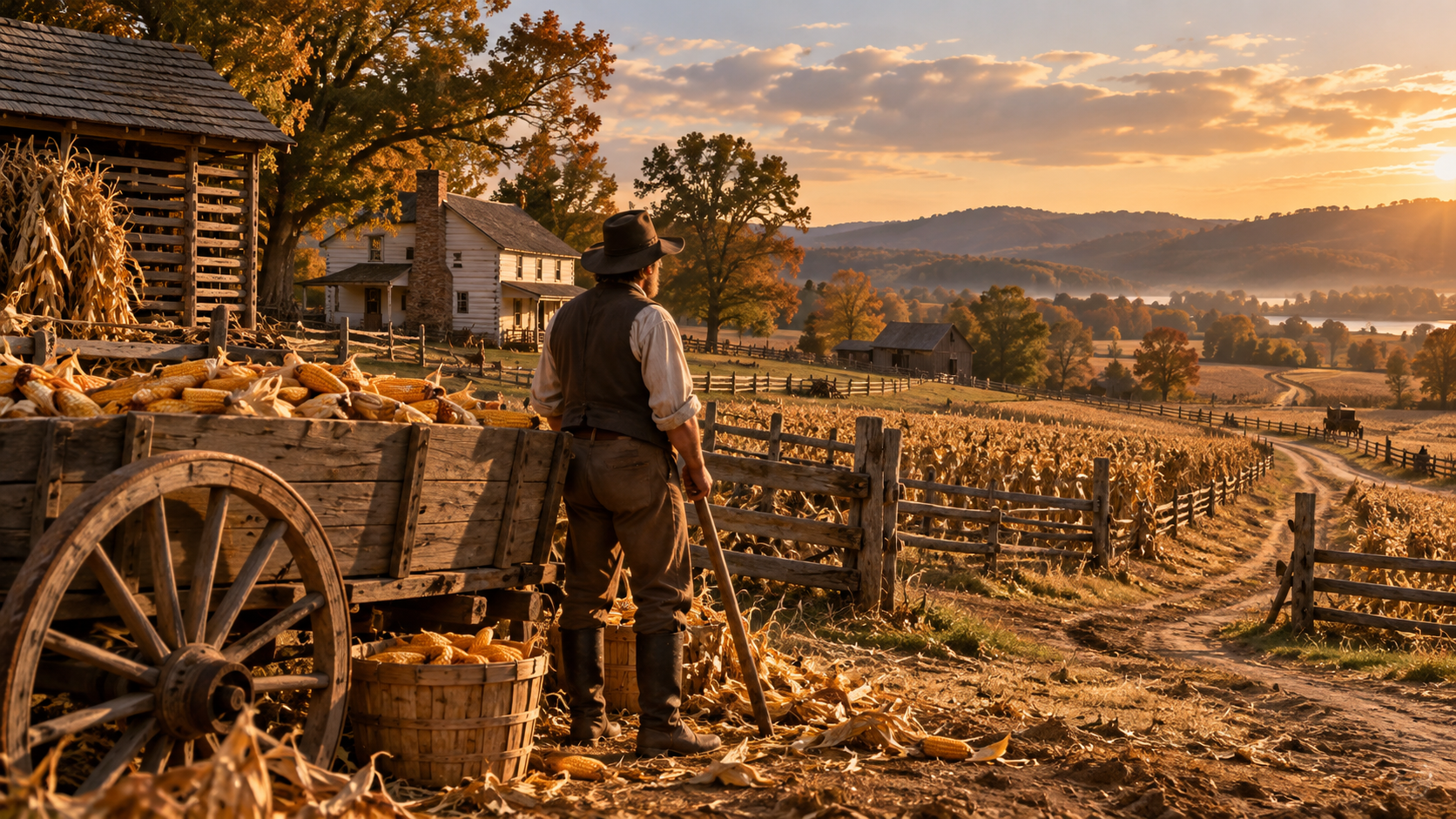
When Enough Became More
When we left our Kentucky farmer, he had done everything within his power to give his crops the best chance of surviving another growing season.
He had chosen his seed, prepared his fields, and spent the months that followed watching the weather and tending the land. He understood that even the most carefully planned harvest remained at the mercy of circumstances beyond his control.
He was simply hoping it would be enough.
But this year, the harvest had been good.
The corn was gathered and stored. Enough had been set aside to feed his family, sustain his livestock through winter, and provide seed for the following spring.
And still, there was corn remaining.
For a farmer accustomed to measuring success by whether his household could survive until the next harvest, that surplus represented something more than abundance.
It represented opportunity.
But opportunity brought questions of its own.
What was that additional corn worth? Who might purchase it? And could it provide something more than the security of another year’s provisions?
The answers were not always simple.
Corn was heavy, roads were difficult, and markets were often far from the farms that supplied them. The expense of transporting a wagonload of grain could consume much of what a farmer hoped to earn from selling it.
Yet farmers had long understood that grain could hold value beyond the field.
It could be milled, traded, sold, or transformed into something that was easier to transport and potentially more profitable.
Whiskey was one of those possibilities.
And for some farmers, the decision to turn a portion of their harvest into whiskey would eventually change not only the fortunes of their farms, but the future of American distilling.
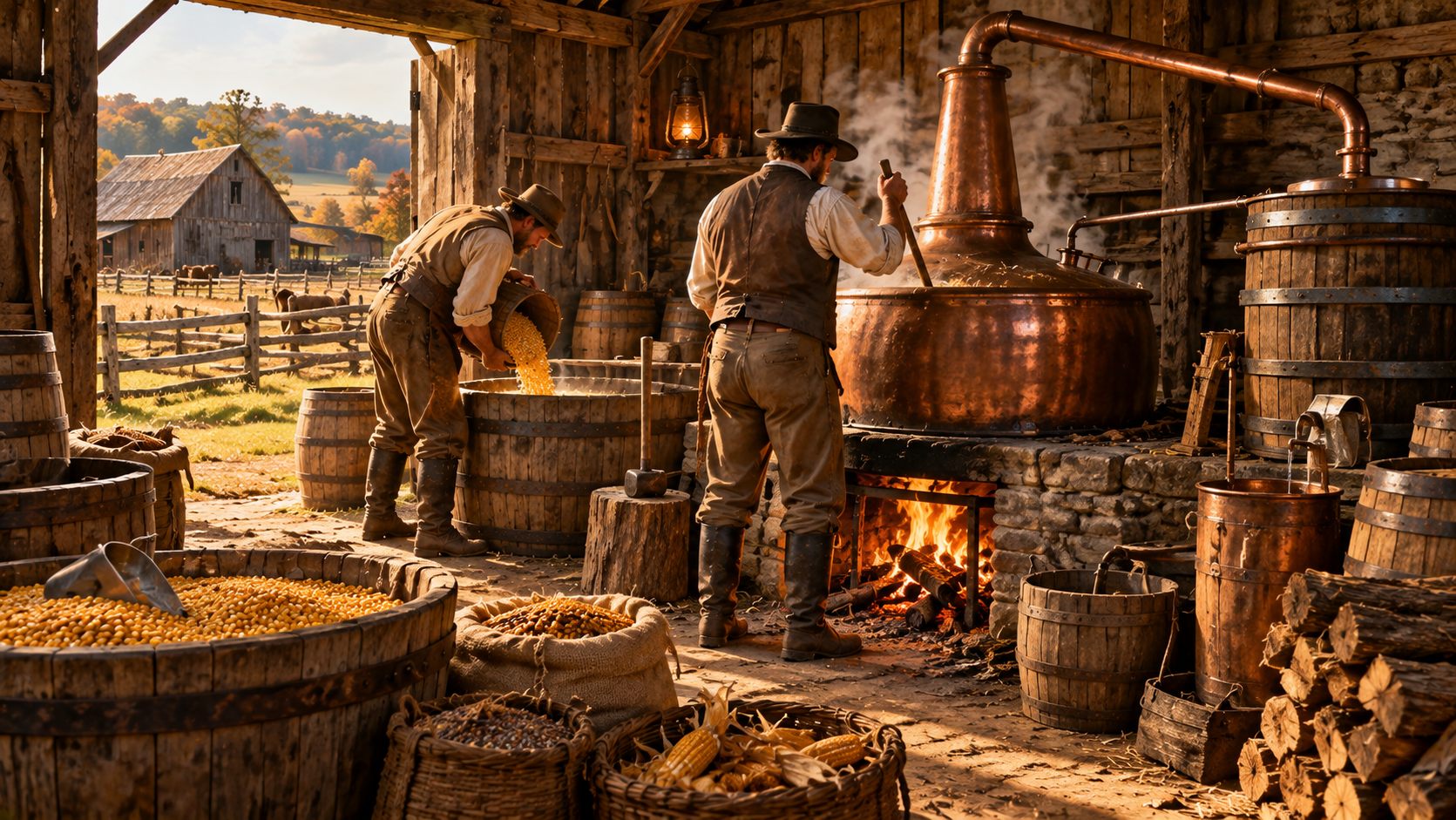
The Still Belonged to the Farm
Today, we tend to separate farming and distilling into two distinct occupations.
One produces the grain.
The other produces the whiskey.
But in the opening decades of the nineteenth century, that distinction was often far less pronounced.
A Kentucky farmer might grow corn, raise livestock, operate a mill, and distill whiskey as part of the same agricultural enterprise.
His still was not necessarily the beginning of a separate business. It could be another piece of equipment used to increase the value of what his land produced.
But making whiskey required more than having grain to spare.
Water and timber had to be available. Grain needed to be harvested, dried, stored, and prepared for milling. Equipment required maintenance, fermentation demanded attention, and tending a still required both experience and labor.
The farmer who understood his fields already possessed some of the practical knowledge that distilling demanded.
He knew how weather could affect stored grain. He understood that temperature mattered and that the same crop might behave differently from one season to the next.
Yet turning that grain into whiskey introduced challenges of its own.
A successful harvest did not guarantee successful whiskey.
Just as the farmer learned to recognize changes in his fields, the distiller learned to recognize changes in his mash. Both relied on observation, experience, and knowledge passed from one season to the next.
And for a farmer willing to invest the time, resources, and labor, the still offered another opportunity to turn the work of his land into income.
For many farming families, distilling was not a departure from agriculture.
It was an extension of it.
A Farm That Used Nearly Everything
For a farmer accustomed to finding a purpose for nearly everything his land produced, the value of distilling did not necessarily end with the whiskey.
After distillation, the remaining grain and liquid, commonly called stillage or slop, could provide supplemental feed for livestock.
For a farmer raising hogs or cattle, this mattered.
Livestock required substantial feed, particularly during the colder months when pasture was limited. Although fermentation and distillation changed the composition of the grain, some of its nutritional value remained in the spent material.
What had already produced whiskey could still serve another purpose on the farm.
This created an important relationship between the stillhouse and the barnyard.
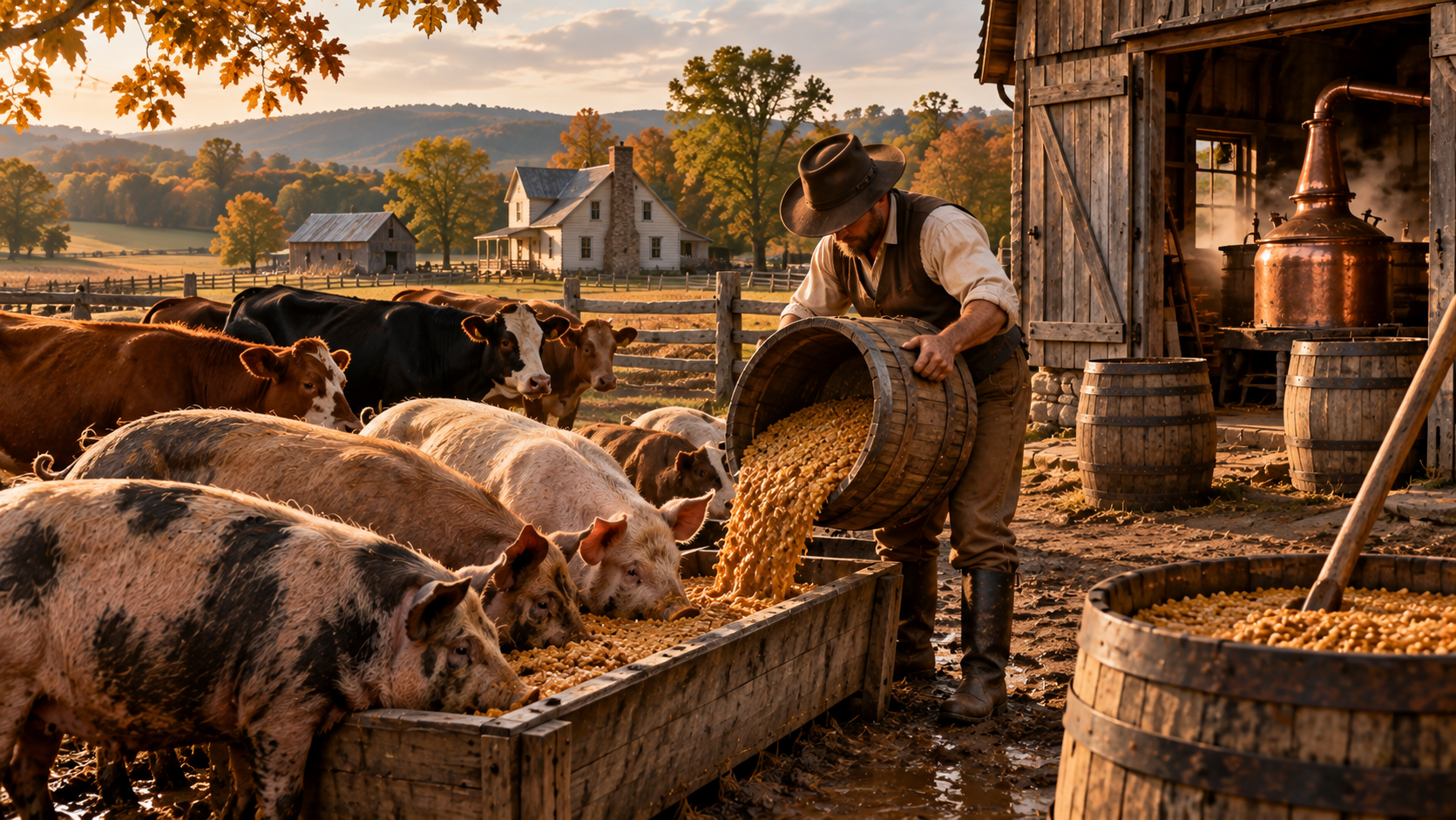
The grain produced whiskey that could be sold or traded. The remaining stillage could help feed livestock, which in turn provided meat and another source of income.
And the manure could return nutrients to the fields that would produce another harvest.
Of course, this arrangement was not without costs. Distilling required timber, water, equipment, and labor. Not every farm possessed the resources to operate a still, nor did every farmer choose to do so.
But for those who did, the opportunity to draw more than one form of value from a harvest made distilling an attractive part of the agricultural economy.
The farm was not simply a place where whiskey’s ingredients originated.
It was a working system in which grain, livestock, labor, and commerce were closely connected.
When the Fields Grew Quiet
The agricultural calendar also shaped the work of distilling.
Spring brought planting.
Summer demanded cultivation, repairs, livestock care, and the endless attention required by growing crops.
Autumn was consumed by harvest.
Winter offered a different rhythm.
Although farm work never truly stopped, the colder months could provide opportunities to devote more labor to processing the harvest. Cooler weather could also make fermentation temperatures easier to manage than during the heat of summer, when controlling conditions inside the stillhouse presented additional challenges.
For some farmer-distillers, whiskey production fit naturally into this seasonal pattern.
With the most demanding fieldwork behind them, farmers could devote more attention to turning a portion of their harvest into whiskey.
But distilling was not exclusively winter work, nor did every farmer follow the same schedule.
The size of an operation, availability of labor, water, timber, equipment, and local demand all influenced when and how often whiskey was made.
A farmer producing modest quantities might organize his distilling around other agricultural responsibilities.
Another, with greater resources or growing demand for his whiskey, might devote considerably more time and investment to the still.
And here, an important distinction begins to emerge.
For some farmers, distilling remained one of several ways to earn income from their land.
For others, whiskey production was becoming a business worthy of greater investment.
Both remained connected to agriculture.
But the opportunities before them, and the decisions they made, could lead their farms in very different directions.
Whiskey Was Worth the Work
For farmers who understood the value of their harvest, distilling offered more than a way to overcome the challenges of storing and transporting grain. It offered an opportunity to increase the value of what their land produced.
It was an economic calculation.
A farmer had already invested considerable labor in producing his crops. Planting, cultivation, harvesting, and storage required time and resources long before a single bushel could be sold.
But not every grain offered the same opportunity.
Corn, rye, and wheat were all part of early American agriculture, and all found their way into whiskey production. Farmers and distillers used different combinations of these grains, influenced by what they could grow, what was available, and the traditions they had brought with them.
Yet the value of a grain was not determined solely by what it could produce in a still.
Wheat was certainly no stranger to the still. Early American distillers used it both independently and in combination with other grains. Yet wheat occupied a particularly important place in the agricultural economy because of its value for flour and bread. Where it commanded a favorable price, a farmer might find it more profitable to sell his harvest to a miller or merchant than to distill it. Corn and rye could offer different economic opportunities, depending on local demand, transportation costs, and the success of the growing season.
For the farmer, the question was not simply what he could distill.
It was what made the most economic sense.
Selling grain offered one way to recover his investment.
Distilling offered another.
Whiskey could command a market value that made the additional work worthwhile, particularly where transporting bulky grain was difficult.
But the advantage was not automatic.
Distilling required equipment, water, wood, labor, and knowledge. Equipment could fail, production could be lost, and market prices could fluctuate.
Profit depended on more than the number of bushels harvested.
It depended on what the farmer could make from them, what production cost, and what someone was willing to pay.
These were considerations familiar to agricultural families. Farmers had always weighed the value of their labor against the uncertain rewards of the land. They decided which crops to plant, which animals to raise, what to keep, and what to sell.
Distilling added another opportunity to those decisions.
As demand for whiskey grew beyond the immediate community, the relationship between the crop and the finished product became increasingly deliberate.
Rather than determining how much whiskey he could produce after the harvest, a farmer might begin planning part of his agricultural production with distilling in mind.
The distinction is subtle, but important.
Corn was no longer valuable only because it could sustain the farm.
It could also support a growing commercial enterprise.
And for some Kentucky farmers, that enterprise would become an increasingly significant part of their livelihood.
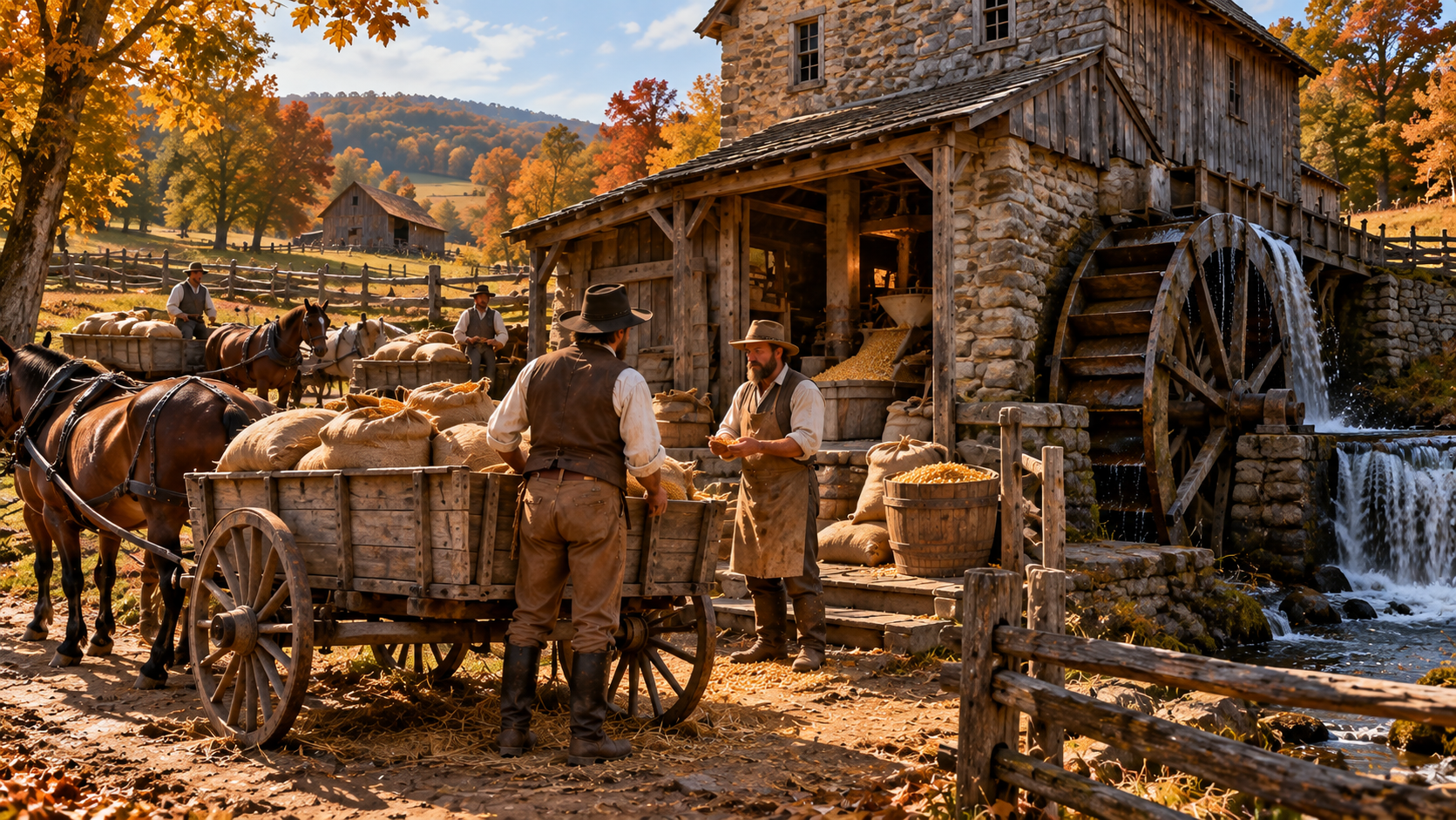
The Road to the Mill
Not every farmer owned a still.
Nor did every farmer have the equipment needed to prepare grain for distilling.
The local gristmill therefore occupied an important place in the agricultural economy.
For generations, mills had provided an essential service by grinding grain into meal or flour. Farmers brought corn, rye, and wheat to be processed, often compensating the miller through an arrangement known as the miller’s toll.
Rather than paying in money, the farmer surrendered an agreed-upon portion of his grain in exchange for the milling service.
For the miller, that grain represented income.
He could sell it, use it to support his own household or agricultural operation, or put it toward other commercial activities. For a miller who also operated a still, the grain collected through tolls offered another possibility: a supply of raw material that could be used in whiskey production.
The arrangement illustrates how closely agricultural commerce and distilling could intersect, even when the farmer bringing his grain to the mill had no intention of producing whiskey himself.
A farmer might bring wheat to the mill because flour was valuable for his family or for sale. Another might bring corn intended for meal or livestock feed. And a miller who also distilled whiskey could find himself with access to grain from several neighboring farms.
But a mill was more than a place where grain passed between heavy stones.
It was also a place where agricultural knowledge traveled.
Farmers encountered neighbors whose fields had endured different weather, whose seed had produced better or worse results, and whose experiences might influence decisions in the coming season.
They exchanged information about crops, livestock, prices, and the practical difficulties of farming.
And as agricultural commerce developed, mills could become part of a broader network connecting farmers, merchants, and distillers.
Some milling operations were associated with distilling. Others supplied meal to customers who operated their own stills.
The arrangements varied from one community to another.
Yet the mill represented something important.
It was a point where the work of an individual farm became connected to the economic activities of its neighbors.
A farmer might arrive with corn he intended to use himself.
Another might bring grain destined for sale.
A third might be producing whiskey and need more meal than his own farm could provide.
Their reasons differed, but their livelihoods increasingly intersected.
And as demand for whiskey grew, those relationships would become more important.
Along Glenn’s Creek
In Woodford County, Kentucky, the history of the Pepper family offers a remarkable glimpse into the changing relationship between agriculture and whiskey production.
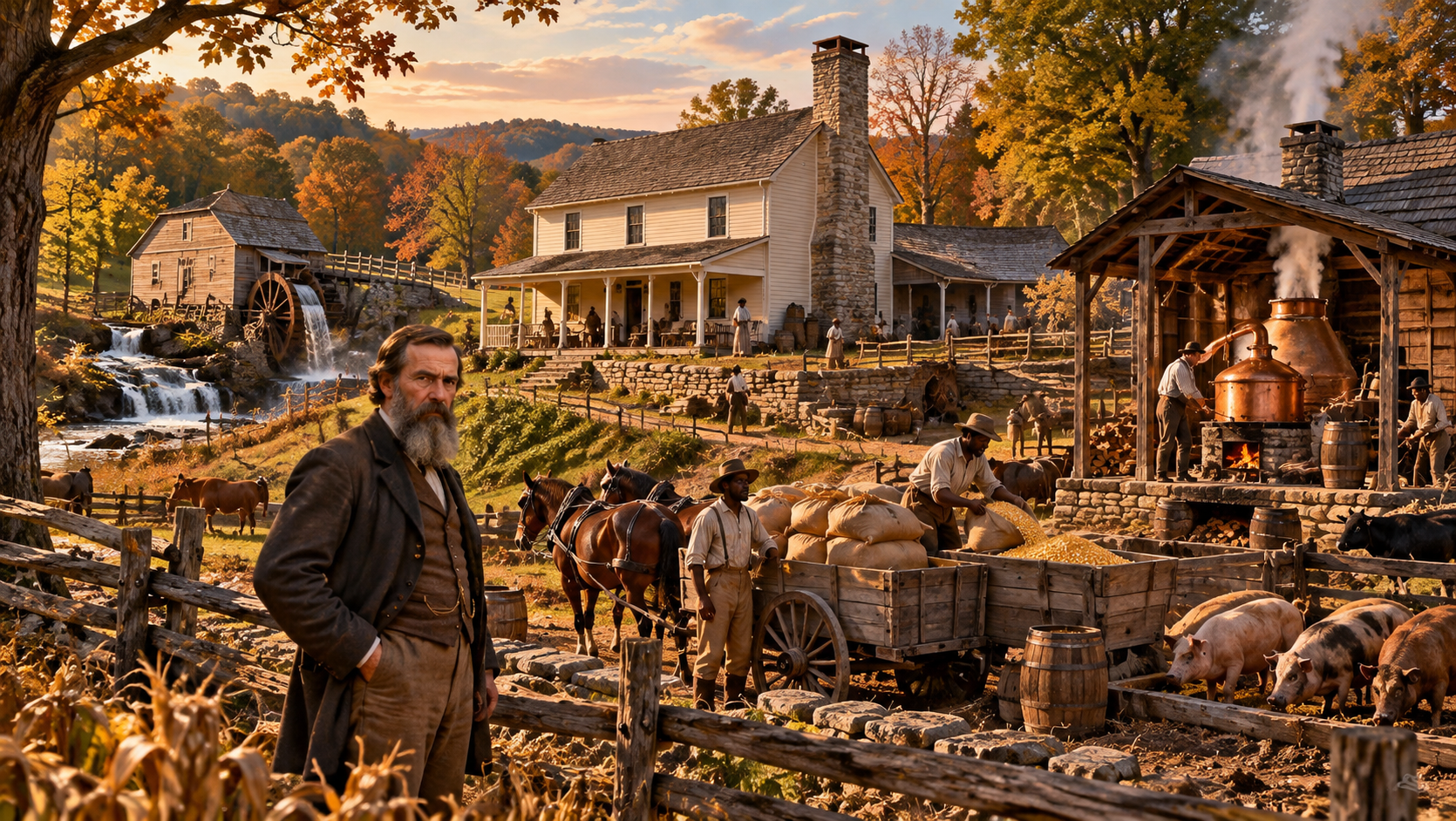
Elijah Pepper was no stranger to distilling when he arrived in Kentucky during the 1790s. His experience began in Culpeper County, Virginia, where farming and distilling were closely connected. Like other farmer-distillers of his generation, Pepper understood that whiskey offered an opportunity to increase the value of what the land produced.
After settling in Woodford County, he continued distilling near Versailles. But as Kentucky’s population expanded and agricultural commerce developed, Pepper’s enterprise grew.
In 1812, he established an operation along Glenn’s Creek, a few miles outside Versailles.
The location offered important advantages.
Fertile farmland provided opportunities for growing grain and raising livestock. The creek and surrounding limestone geology offered valuable water resources for milling and distilling. And the growing communities of central Kentucky provided markets for agricultural products, including whiskey.
But what makes Elijah Pepper’s operation particularly interesting is not simply where he made whiskey.
It is the scale of the agricultural enterprise he developed.
By the time of his death in 1831, Pepper’s property represented far more than a modest farm with a still tucked behind the barn.
His estate inventory reveals a substantial operation involving agriculture, livestock, and whiskey production.
Among the livestock recorded were 113 hogs, 125 sheep and lambs, and more than 30 cattle.
These numbers offer an important glimpse into the agricultural economy surrounding the distillery.
Livestock was not separate from the business of making whiskey. The two activities could support one another.
After distillation, the spent grain and liquid remaining in the stillhouse could be used as supplemental feed for cattle and hogs. This allowed farmers to recover some of the nutritional value of grain that had already served another purpose.
The animals, in turn, provided additional opportunities for income through meat and livestock sales.
Manure could also be returned to the fields, contributing nutrients to future crops.
It was an agricultural relationship in which one activity could create value for another.
And the whiskey operation itself had become substantial.
Pepper’s estate inventory included six copper stills, 74 mash tubs, and 41 barrels of whiskey containing approximately 1,560 gallons.
These were not the holdings of a farmer who occasionally distilled a few bushels of leftover corn.
They reflected considerable investment in equipment, production capacity, and whiskey intended for storage or sale.
Grain remained at the center of the enterprise.
Corn, rye, and wheat served the household, livestock, local markets, and the stillhouse. Milling was essential to preparing grain for many of these uses, and Pepper’s gristmill connected agricultural production directly to his distilling operation.
The mill could process grain from his own fields while also providing milling services to neighboring farmers. Under the traditional miller’s toll arrangement, a portion of the grain processed could serve as payment, creating another potential source of agricultural income.
Whiskey production also depended on the surrounding timber resources. Wood provided fuel for heating stills, while barrels and other wooden vessels were necessary for handling, storing, and transporting the finished product.
The inventory of mash tubs and whiskey barrels demonstrates just how important these materials had become to Pepper’s operation.
But an enterprise of this size required more than fertile land and dependable water.
It required labor.
The 1830 federal census recorded 25 enslaved people held by Elijah Pepper, reflecting both the wealth he had accumulated and the substantial workforce supporting his agricultural enterprise.
Cultivating fields, tending livestock, cutting timber, milling grain, maintaining equipment, and producing whiskey all required labor. Although the census does not identify individual work assignments, enslaved workers were an important part of the agricultural and economic system that made operations of this scale possible.
By the time of his death in 1831, Pepper had developed a substantial agricultural business in which land, livestock, labor, and distilling were closely connected.
The fields supplied agricultural products.
The mill prepared grain for use.
The stillhouse transformed part of that grain into whiskey.
Livestock provided another source of agricultural value.
And the finished whiskey offered opportunities for income beyond the sale of grain itself.
This was not simply a farmer looking for something to do with an abundant harvest.
It was an agricultural enterprise in which whiskey production had become an increasingly significant commercial activity.
And that distinction matters.
The growth of American whiskey did not begin only when large commercial distilleries appeared.
It was already taking place on farms where successful distillers invested in greater production capacity, expanded their agricultural operations, and developed businesses that extended beyond the needs of a single household.
Elijah Pepper’s operation illustrates how far that development could progress while remaining closely connected to agriculture.
But the family’s story did not end with Elijah.
When he died in 1831, his son Oscar continued the family business.
Oscar inherited an established agricultural and distilling enterprise, one that already represented considerable investment in whiskey production.
He would build upon that foundation.
Under Oscar’s direction, the business became increasingly specialized, reflecting the changing opportunities available to Kentucky whiskey producers. His association with Scottish physician and distiller Dr. James Crow during the 1830s would become an important part of that development.
Greater attention to production methods, consistency, and commercial expansion would help distinguish the next generation of Kentucky distilling.
But those changes did not eliminate the agricultural foundations upon which the business depended.
Corn still had to be grown.
Grain still had to be milled.
Water, fuel, and labor remained essential.
And as distilling businesses expanded, their demand for agricultural resources could extend beyond what their own land could provide.
The Pepper family’s history illustrates one direction that successful farm distilling could take.
Not every Kentucky farmer operated on Elijah Pepper’s scale.
Some continued making whiskey in modest quantities. Others found greater opportunity growing grain, raising livestock, operating mills, or selling their harvests to neighboring distillers.
But for those with the resources and opportunities to expand, distilling could grow from one part of an agricultural livelihood into the principal business of the enterprise.
The transformation was gradual.
The farmer did not suddenly disappear when whiskey production became more commercially significant.
In many cases, the distilling business grew from the agricultural enterprise itself.
And as that growth continued, the relationship between the farmer and the distiller began to change.
More Corn Than One Farm Could Grow
A farmer who distilled his own harvest understood exactly where his grain came from.
He knew the fields.
He knew the seed.
He remembered whether the summer had been unusually wet, whether the corn had matured properly, and whether the harvest had been stored in good condition.
But what happened when a distilling operation needed more grain than its own acreage could supply?
For a successful farmer-distiller, that question could arise even after a productive harvest.
The land still had to provide food for the household, feed for livestock, and seed for the following growing season. A farmer might already be making the best use of his available acreage, yet find that demand for his whiskey was growing beyond what his own harvest could support.
And as we’ve seen, not every grain grown on the farm was necessarily destined for the still.
A farmer had to consider the value of each crop, the needs of his household and livestock, and the opportunities available in the marketplace.
As his whiskey business grew, purchasing additional grain from neighboring farms could become a practical way to increase production without sacrificing the other needs of his agricultural operation.
That arrangement created opportunities on both sides.
The distiller gained access to more grain.
The farmer gained another potential buyer for his crop.
And the relationship between agriculture and distilling became increasingly interconnected.
This did not mean that farmers suddenly abandoned their stills.
Nor did it mean that every distiller stopped growing grain.
The boundaries remained flexible.
A farmer might continue distilling part of his own harvest while selling additional corn.
Another might decide that growing grain was more profitable than investing in distilling equipment.
A third might expand his whiskey production and begin purchasing from neighboring farms.
These arrangements could exist within the same community.
And they reveal something important about the beginnings of Kentucky’s whiskey trade.
The development of larger distilling operations did not immediately remove farmers from whiskey production.
Instead, it created additional ways for them to participate.
The farmer could remain the distiller.
He could become a supplier.
Or he could be both.
The relationship was evolving, but the agricultural foundation remained firmly in place.
A Market Beyond the Farm
For much of America’s early settlement, geography placed limits on agricultural commerce. A farmer might produce an excellent crop and still struggle to find a profitable market for it. Roads were often difficult, wagons could carry only so much, and the expense of transporting heavy grain over long distances could consume much of what a farmer hoped to earn.
Whiskey offered another possibility.
Local taverns, merchants, and neighboring settlements provided opportunities to sell or trade whiskey, but growing commercial centers offered access to larger markets. Pennsylvania had long been an important center of American whiskey production, while Kentucky and Tennessee were developing substantial distilling economies of their own. Pittsburgh, Lexington, Louisville, Cincinnati, and Nashville connected producers with merchants and buyers. Farther south, New Orleans became an important destination for whiskey moving through the Mississippi River system, opening access to markets throughout the South and beyond.
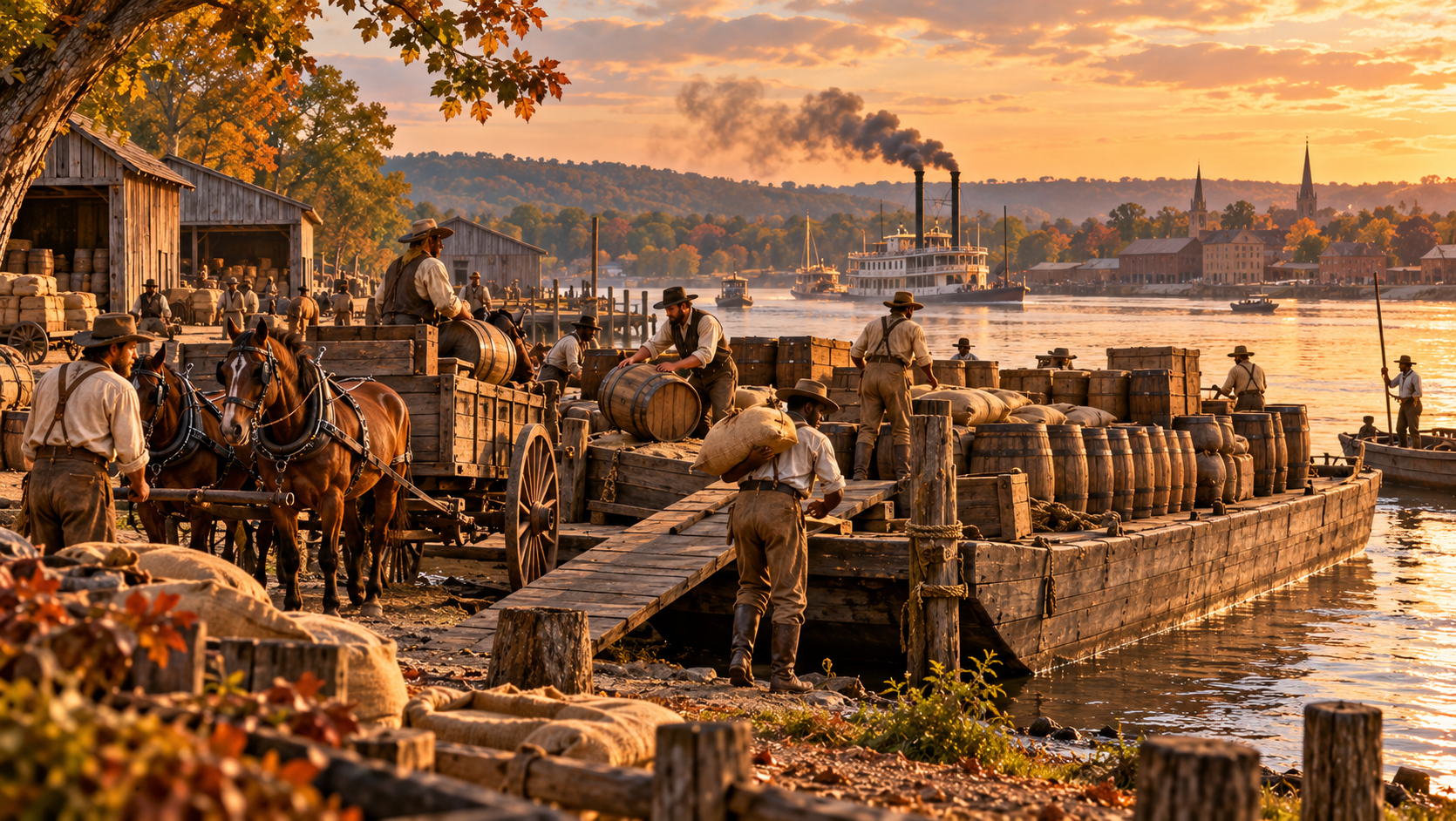
But reaching those markets was no small undertaking. Before steamboats made upstream navigation practical, flatboats carried whiskey and other agricultural products down the Ohio, Cumberland, Tennessee, and Mississippi rivers. Built primarily for downstream travel, most were dismantled and sold for lumber upon reaching their destination. For farmers and merchants who accompanied their goods to New Orleans, returning home presented another challenge. Many traveled north by way of the Natchez Trace, an established overland route connecting Natchez, Mississippi, with Nashville, Tennessee, before continuing toward their homes. The possibility of receiving a better price in distant markets helped justify the risks, but transportation expenses, uncertain demand, and the dangers of travel could quickly diminish the profits. Other producers avoided the journey altogether, selling their whiskey to merchants who assumed responsibility for getting it to market.
As steamboats expanded river commerce during the early nineteenth century, followed by canals and eventually railroads, the movement of whiskey became increasingly efficient. Larger quantities could reach distant markets, and merchants developed more established relationships with producers. These improvements did not bring an end to farm distilling. Instead, they created additional opportunities for farmers who continued making whiskey and those who supplied grain to growing distilleries.
A farmer might never travel beyond his county.
He might never see the riverboats carrying whiskey toward distant cities.
But if a nearby distiller found more customers, that distiller might need more corn.
And more demand for corn could create new opportunities for the farmers who grew it.
The river did not replace the farm.
It helped connect the farm to a larger economy.
The Farmer Still Chose the Seed
Through all these changes, the farmer continued facing the same fundamental questions that had shaped agriculture for generations.
What would grow best in his fields?
What could withstand an uncertain spring?
Which corn would mature before the first hard frost?
What would store safely through winter?
And what would provide the greatest value for the work invested?
The arrival of new commercial opportunities did not erase those concerns. It added another consideration: what the market might demand.
As whiskey production expanded, a dependable harvest could mean more than food for the household and feed for livestock. It could provide grain for sale, supply a neighboring distillery, or become whiskey destined for markets far beyond the farm.
Yet the farmer’s choices remained grounded in the realities of his land.
The Flint and Gourdseed varieties discussed in Part II did not simply disappear as commercial distilling grew. Farmers continued planting, exchanging, crossing, and selecting corn according to their experience and needs.
Over time, those practices contributed to the development and spread of other varieties, including the dent corns that would become increasingly important in American agriculture.
But this was not an overnight transformation, nor was it driven by whiskey alone.
Farmers selected corn for food, livestock, milling, storage, yield, and the demands of an expanding agricultural marketplace. Distilling was one part of that larger economy.
And regardless of how far whiskey might eventually travel, its beginnings remained subject to the uncertainties of agriculture.
No steamboat could make a poor field productive.
No merchant could guarantee the weather.
No distiller could purchase corn that had never survived the growing season.
The whiskey trade might be expanding, but its success still depended on the agricultural knowledge of the people working the land.
Before the Barrel
As another growing season approached, our Kentucky farmer returned to the same questions that had occupied him the year before.
Would the soil be ready?
Would the spring rains arrive?
Would the seed he had saved produce another dependable harvest?
Those concerns had not changed.
But the possibilities surrounding his harvest had grown.
Corn could feed his family.
It could sustain his livestock.
It could be traded, milled, or sold.
And with the right knowledge, equipment, and labor, it could become whiskey.
Whiskey that might provide income beyond what the grain itself could bring.
Whiskey that might help pay debts, purchase equipment, acquire land, or improve the family’s financial security.
The farmer had not stopped thinking about survival.
He was also considering what prosperity might look like.
Across Kentucky, farmers were making decisions that reflected both the needs of their households and the opportunities of a growing marketplace.
Some invested in stills.
Others expanded operations they had already established.
And some found new customers for their grain as neighboring distilleries grew.
Together, those decisions were helping shape something larger than any one farm.
But the transformation was only beginning.
The distillery had not yet become entirely separate from the agricultural world that sustained it.
The farmer had not surrendered his place in whiskey’s story.
He was still planting the corn.
Still selecting the seed.
Still bringing in the harvest.
And sometimes, still tending the fire beneath the still.
Because long before bourbon became an industry, whiskey was already part of the business of farming.
And before the farmer became a supplier to the distillery, he was often the distiller himself.
